
What Chinese Households Actually Do Every Autumn (And Why It Works)
September 22, 2026
Ask someone who grew up in a Chinese household what autumn feels like, and a lot of them will describe the same scene: a parent or grandparent looking you up and down in early autumn and saying, more or less, “don’t put that on yet — tough it out a little.” Multiply that by a dozen other small habits — the fruit bowl quietly changing over, a pot simmering on the stove that wasn’t there in July, someone insisting you soak your feet before bed — and you’ve got an entire seasonal system that nobody ever explains all at once. It’s just absorbed, one comment at a time, over years. Here’s the whole thing laid out, with the actual reasoning behind each piece.

Toughing it out, on purpose
The instruction is usually just “扛一扛” — hang in there a little. The logic underneath it: your body needs a buffer period. All summer your pores have been open, working hard to dump heat. If the temperature drops two degrees and you immediately bundle up to compensate, those pores stay shut down before they’ve had any practice handling cold — and by the time real winter arrives, your body has lost the capacity to tolerate it.
That said, “tough it out” doesn’t mean actually shivering. Three spots don’t get to skip the memo: the back of the neck (right around the acupoint Dazhui, where cold is thought to get in fastest), the lower back on both sides (the traditional seat of the Kidneys — let that get cold and your whole sense of drive and warmth drops with it), and the ankles (the soles of the feet are treated as a direct entry point for cold). The practical version: a thin jacket is fine, but keep a scarf around your neck and socks on your feet. Toughing it out with limits, not toughing it out blind.

Why the fruit bowl changes overnight
Around the solar term marking autumn’s start, Chinese households start putting away the watermelon and cantaloupe and bringing out pears, persimmons, pomegranates, jujubes, and lotus root instead.
That swap isn’t arbitrary. Watermelon has a nickname in Chinese medicine — “the natural White Tiger Decoction,” after a classical formula (Bai Hu Tang) used specifically to clear intense heat from the body. It’s genuinely useful in summer for exactly that reason. But by autumn, your digestion has already spent a whole season processing cold drinks and chilled food, and it’s tired. Handing it more watermelon is like asking someone who just finished a night shift to pick up another one — it tends to show up as bloating or loose stools instead of relief.
Autumn’s actual seasonal foods do the opposite job: pear (moistens the lungs, eases coughing), lotus root (nourishes fluids, clears lingering heat), yam (strengthens the spleen and stomach), snow fungus (moistens skin and the respiratory tract). What they share is the same basic character — moistening, gently warming, nothing harsh. That’s the real substance behind the old phrase “eat what’s in season and nothing else” (不时不食): not a rule for its own sake, but a fairly precise read on what your body actually needs at that point in the year.
Why every kitchen starts simmering something
Walk into a Chinese kitchen in autumn and there’s a decent chance something is quietly bubbling — a sweet snow fungus and lotus seed soup, a yam and pork rib broth, an old-style duck soup.
The reason behind it has a name: autumn dryness (秋燥). A full summer of sweating, air conditioning, and short sleep already draws down the body’s fluid reserves, and autumn’s dry wind pulls out what’s left even faster. The signs are familiar if you’ve felt them: dry skin, a scratchy throat, cracked lips, excess phlegm, constipation.
Snow fungus, once soaked, turns soft and slippery — in this framework it’s treated as laying a thin film of moisture over dried-out internal “piping,” nourishing the lungs and skin specifically. Yam does double duty, strengthening digestion while also moistening the lungs. Duck is considered a cooling meat, which makes it useful here for nourishing fluids without adding more heat on top of an already-dry season. None of this is guesswork — it’s the result of a few thousand years of people testing what actually settles their own symptoms.
The White Dew piece goes deeper into autumn dryness specifically, including how to tell which version of it you actually have.
Going to bed with the days, not against them
Staying up a bit late in summer is no big deal — the days are long, and yang energy runs outward. The moment autumn actually arrives, though, the advice changes fast: stop staying up.
The reason is the shift in daylight itself. Days get shorter, nights get longer, and the natural world’s energy starts drawing inward instead of outward — the same instinct that sends migratory birds south and has bears packing on weight before hibernation. The body is meant to follow that same contraction rather than fight it.
It’s easy enough to test: sleep by 11pm and get up by 7am, every day, for one week straight. By the end of it, most people notice their skin isn’t as dry, mornings feel less like dragging themselves upright, and their throat doesn’t feel as parched. That’s not a placebo effect — it’s the body’s own clock falling back into sync with the season around it.
“Padding up for autumn” was never a license to overeat
“贴秋膘” — padding up for autumn — might be the most famous of all these habits, and it’s also the most commonly misunderstood. A lot of people take it to mean autumn is open season for eating whatever you want. The traditional version is actually much more restrained — closer to a gentle repayment than a free-for-all.
The reasoning: a hot, sweaty summer usually means a smaller appetite and a bit of lost weight by the time it ends. Once the weather cools and appetite comes back, that’s the moment to rebuild what was spent — but carefully. Beijing’s version is instant-boiled mutton hot pot, warming to the blood. Jiangnan’s version leans on duck, which nourishes fluids and eases dryness. Cantonese households favor slow-simmered soups, built up gradually rather than all at once. What they all have in common is the method: warm, gently stewed food, not fried or grilled. Digestion is still worn out from summer, and hitting it with heavy fried food on top of that tends to backfire rather than help.
The cheapest medicine is a basin of hot water
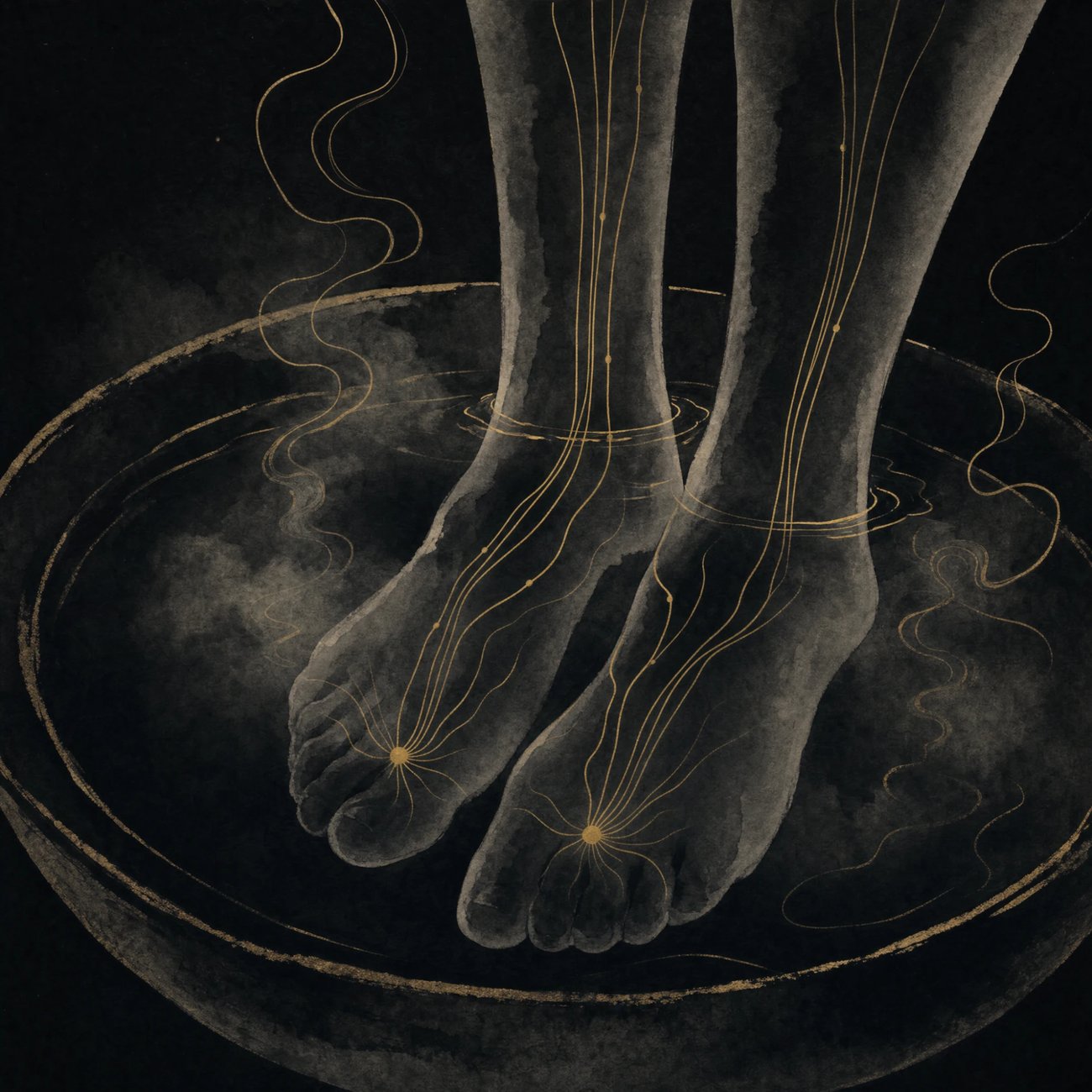
If you grew up in a Chinese household, autumn probably came with someone putting a basin of hot water by your feet and telling you to soak them.
The physiology underneath it is straightforward: feet are the part of the body furthest from the heart, and the first to lose warmth when the temperature drops. Once feet get cold, circulation everywhere else slows down with them — cold hands and feet in autumn often trace straight back to cold feet in the first place. Water at around 40°C sends warmth up from a point on the sole called Yongquan (“Bubbling Spring”) along the body’s meridian pathways. After 15 to 20 minutes, a lot of people feel their back warm up and the rest of them relax along with it — not a mystical effect, just blood vessels dilating and circulation picking up the way they normally do with heat. The best time to do it is about an hour before bed; climb into a warm bed straight afterward and sleep tends to come easier, no supplement required.
“Autumn sorrow” is real, and it’s your body talking
There’s a phenomenon Chinese culture noticed early enough to give it its own name: 悲秋, autumn sorrow — a wave of low mood, wistfulness, or unexplained tearfulness that shows up for a lot of people once the season turns.
The likely reason: the natural world visibly withers in autumn, turning from full growth to decline, and watching that happen tends to stir up its own quiet sense of time passing and things ending. That reaction is normal on its own. Left unchecked for too long, though, it starts to take a physical toll. Chinese medicine has a specific line for it — grief and worry are said to injure the Lung — and a weakened Lung means weaker immunity, which is part of why autumn colds and coughs tend to cluster around people already sitting in a low mood.
The traditional fix is almost embarrassingly simple: get outside when the sun’s out. Nothing strenuous — even twenty minutes of walking, some daylight on your face, a look at the autumn sky, is enough to nudge dopamine up and lift your mood for real, not just as a distraction. Or share a meal or a pot of tea with someone. A lot of autumn’s warmth, in the end, comes less from the weather and more from staying connected to people.
Four words for the whole season
If you had to compress all of it into a single framework, Chinese seasonal wisdom lands on four ideas:
收 (Contract) — pull summer’s sprawling pace back in: sleep earlier, wake earlier, ease off on intense exercise.
润 (Moisten) — counter autumn dryness directly: more pear, snow fungus, and yam, less sleep deprivation.
暖 (Warm) — protect the neck, lower back, and ankles, and don’t let cold quietly drain your reserves.
安 (Settle) — keep your mood steady, and don’t let “autumn sorrow” sit there draining your energy unchecked.
Underneath all of it is one idea: people and the natural world aren’t separate systems. What you do in summer, autumn, and winter was never arbitrary — it’s just what falls out naturally when you actually pay attention to the rhythm you’re already living inside.