
Walking Meditation: The Three Levels That Turn Ordinary Steps Into Practice
Published September 9, 2026
The first time I tried to slow my walk down on purpose, I lasted about four steps before my mind wandered off somewhere completely unrelated — and I didn’t even notice it had happened until I was already halfway down the hall. That’s usually how people find out walking meditation is a real skill, not just a slower version of walking: they assume it’ll be easy, and get quietly humbled within the first minute.
Racking up steps on a fitness tracker doesn’t touch this at all — and it’s worth being blunt about why. Walking with your attention checked out isn’t neutral. In this tradition, it’s described less as “doing nothing” and more as quietly spending down whatever stillness and rest built up overnight, faster than aimless movement can ever pay it back. You can hit 10,000 steps a day for years and never once practice walking meditation, because the two barely resemble each other. One is distance covered while your attention is off somewhere else — your phone, a podcast, whatever’s still bothering you from this morning. The other is closer to standing meditation — a skill built in layers, the same patient way.

Level one: rooting, before you move
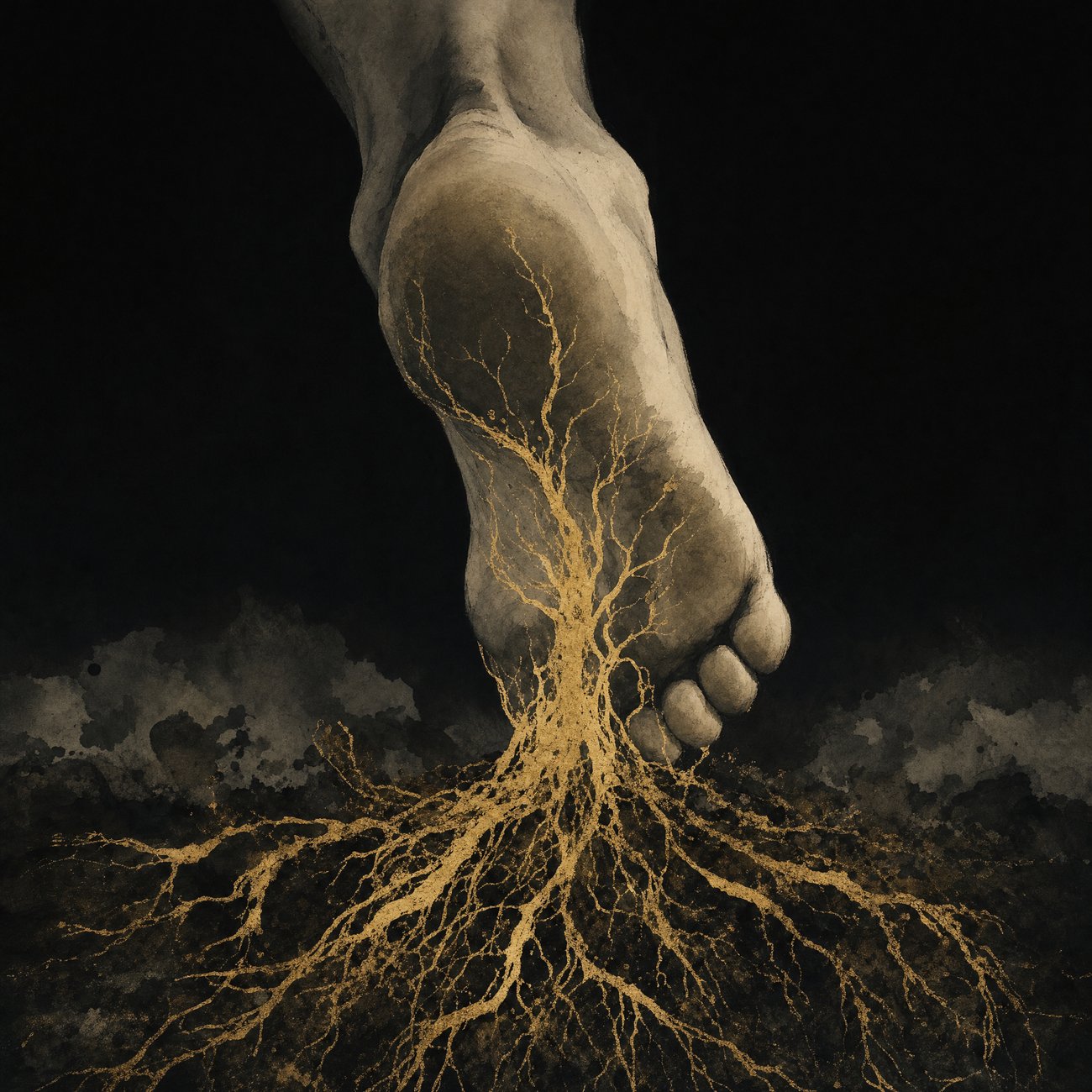
There’s a step before the first real step, and almost everyone skips it: actually landing in your own body. Not thinking about walking — just feeling. The sole of your foot, the ground already under it, your own weight, still, before anything has moved yet.
A step taken without this comes from nowhere — nothing underneath it to draw from, nothing solid to stand on, the way a plant with no root system just drifts on whatever current happens to move it. Try pausing for a real breath before each step and notice how far away your attention usually is — still replaying a conversation, already three steps ahead planning what’s next. Walking meditation asks you to reel that back in on purpose, every time, before you commit to moving. Skip it, and everything after is just a body going through motions while the mind stays somewhere else entirely.
Level two: listening with your feet
Once you’re actually there, the next layer is noticing — not glancing, actually noticing — what happens the instant contact is made. Slow down, more than feels reasonable — some practitioners close their eyes for this, to strip away the distraction of watching your own feet — and pay attention to what ordinary walking never registers: the give of the ground the moment your heel lands, the roll of weight from heel to toe, a response that can travel up through the ankle almost like a small current, the knee loosening as your full weight settles onto that leg, the last light grip of your toes just before you lift off again.
There’s a word for this kind of attention in the internal martial arts — “listening,” though it has nothing to do with your ears. It means staying sensitive to what’s actually happening, moment to moment, instead of assuming you already know because you’ve done it a thousand times. Slow down enough on a path you’ve walked a hundred times, and it stops feeling familiar. You start noticing texture and resistance in ground that used to just be background — go slowly enough, and you can register the small sounds and shifts happening at the joints themselves.
Level three: staying for the whole step
The first two levels get you arriving and sensing. The third is harder to describe and harder to hold onto: staying with a single step all the way through, from the moment your foot lifts to the moment it’s fully settled, without your attention slipping ahead to the next one. The tradition this comes from describes this level in almost historical terms — that the ground under your feet has already held countless other footsteps before yours, other lives, other weather, long before you arrived on it — and holding that thought with real, unhurried attention, rather than rushing past it, is itself part of the practice.
It’s worth being plain about what that means and what it doesn’t. This isn’t a download of ancient energy, and it’s not a shortcut to some grand realization — if a practice promises that kind of dramatic payoff, that promise is usually the problem. What the idea is actually doing is functional: giving your attention something large enough and slow enough to hold onto for the full length of a step, instead of drifting off after half a second the way it normally does. Most people never really reach this level — not because it’s mysterious, but because sustaining attention that long, on something this ordinary, is genuinely difficult.

Walking is only a third of the picture
Here’s the part that’s easy to miss: this tradition never treats walking as a practice on its own. It’s one of three, and the other two are things you already do every day without thinking about them as practice at all.
Sleep is the first — treated less as rest and more as closing a valve, so that whatever’s been built up during the day doesn’t quietly leak away overnight. Eating is the second — not just fuel, but opening the source that lets the body turn food into something usable. Walking, done properly, is the third: it’s what keeps the channels between those two clear, letting everything gathered from sleep and food actually circulate instead of sitting stagnant.
Miss any one of the three and the other two can’t fully do their job either. You can be technically diligent — sleeping on schedule, eating carefully, walking your daily steps — and still end up structurally hollow, busy on the outside with nothing accumulating on the inside. The three aren’t separate habits stacked next to each other; they’re closer to three legs of the same stool.
Putting it together
Find somewhere quiet and flat — a hallway, a garden path, an empty stretch of sidewalk — somewhere you don’t have to think about traffic or watch your footing. Leave the phone behind; this isn’t something you can do in the background of something else. Walk slower than feels reasonable, slower than you think you need to, and let the three levels build on each other: root, then listen, then stay.
Ten or fifteen minutes is plenty to start. There’s no step count to chase and no finish line — walk only for the count at the end and you’ll have walked for nothing, because the point was never the destination, it was the honest step directly underfoot. Some days it comes easily. Other days your mind wanders every few steps and you spend the whole walk gently bringing it back, over and over. That’s not a failed session — noticing the wandering and returning is most of what this practice actually is.
There’s an old line in Daoist thought worth keeping close: reaching up onto your toes to stand taller only makes you less steady, and stretching your stride to cover ground faster only makes you trip. Walking meditation runs on the opposite instinct — smaller and slower beats bigger and faster, almost every time. What it builds shows up the same unglamorous way most real change does — not as one dramatic shift, but as ground that feels a little steadier underfoot than it did last week, one honest step at a time.