
Qigong Exercises for Beginners: Start With One Thing, Not Twelve
Published September 5, 2026 · Updated September 15, 2026
If you’ve searched for qigong exercises as a beginner, you’ve probably landed on a list of eight, ten, or twelve different movements — each with its own name, its own breathing pattern, its own claimed benefit. It’s overwhelming enough that most people bookmark the page, half-remember one exercise a few days later, and quietly stop.
Here’s the part almost nobody says out loud: you don’t need any of those twelve movements yet. There’s one thing that comes before all of them, and until it’s in place, the rest doesn’t do much.
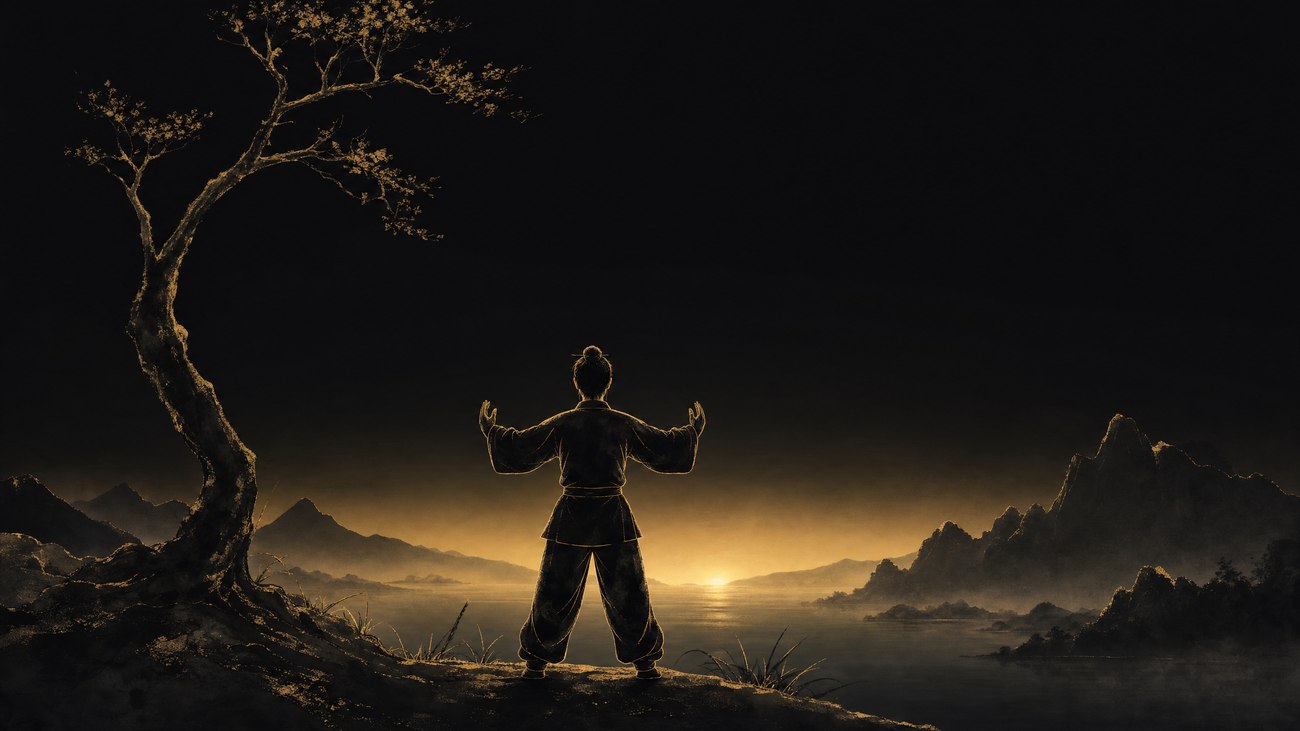
The movements were never the active ingredient
Every qigong form, whatever tradition it comes from, sits on the same foundation: a posture your body can hold without fighting itself, breathing that’s allowed to slow on its own, and attention that stays in the body instead of wandering off.
Skip that and go straight to the impressive-looking movements, and you’re rehearsing choreography without the thing the choreography exists to carry. This is why so many beginners feel qigong “isn’t working” even when they’re copying the movements correctly — they’re layering movement on top of tense shoulders and shallow, hurried breathing.
So the honest first exercise isn’t an exercise at all. It’s learning to stand.
Why standing, and why this particular version
Standing practice — 站桩, zhan zhuang — is the foundation across taiji and the internal arts. But “standing practice” covers several different postures, and for a beginner they are not equally forgiving.
The one usually shown online has the arms raised in front of the chest, as if holding a large ball. There’s nothing wrong with it, but it carries a risk for beginners: if the body isn’t yet open, qi tends to stall in the upper body with nowhere to descend, and over time that shows up as dizziness, disturbed sleep, or cold hands and feet.
The version worth starting with is the plainer one — Wuji standing, where the arms simply hang at your sides, palms resting lightly against the thighs. Nothing is raised, nothing is held, and crucially, there’s no intention to guide and nothing to visualise.
That last part is the whole reason it belongs first. With no intention work involved, a beginner cannot really get it wrong. The worst available outcome is that the benefit comes more slowly. That is not true of many methods, where practising incorrectly is genuinely difficult to undo — I’ve met people who spent more than a decade repairing problems they created in a few months.
It isn’t the most powerful posture. It’s the one least likely to hurt you, which for your first year matters considerably more.
What it actually involves
Enough to start with today:
- Feet parallel, shoulder-width, toes pointing straight ahead.
- Knees softened until they’re no longer locked — a much smaller movement than most people expect, often barely visible.
- Shoulders dropped, then dropped again, an inch further than feels necessary. Arms hanging, palms lightly on the outsides of the thighs.
- Crown of the head lightly suspended, as though lifted by a fine thread, with the chin very slightly drawn in.
- Breath left completely alone. Don’t deepen it, don’t count it.
Then the part that takes the actual practice: find the tension and let it go, over and over. Jaw, shoulders, hands, thighs. The aim isn’t to go limp — it’s for the skeleton to carry the weight while the muscle stops helping.
There’s an old way of putting this that makes it click faster than any anatomical description: the bones support, and the flesh hangs on the bones. Look for the feeling of hanging.
How long
Start at 10 to 15 minutes. Build toward 40 minutes over time, and after that go by feel — but don’t exceed an hour.
One long session beats several short ones: forty minutes in a single stretch does considerably more than four ten-minute sessions scattered through the day. Morning or before noon is ideal. Don’t practise within an hour of eating, or after drinking.
What early progress actually feels like
Quiet, not dramatic — and the first two weeks are the least pleasant part.
Expect aching in the legs, knees, lower back, shoulders and neck, and general tiredness. That’s adaptation, not a mistake, and it starts receding from around the third week. Somewhere in the third or fourth week a sense of ease shows up, and once your sessions reach twenty minutes or so, warmth tends to spread through the body.
If you get a warm, tingling or heavy sensation, that’s a well-documented experience — but it isn’t a requirement, and chasing it is a classic beginner trap. Plenty of people practise successfully for months without a strong version of it. Notice, don’t steer.
Shaking legs, by the way, are normal early on and usually just mean a weaker constitution. Take it slowly, but keep going if you can — it passes.
Common mistakes worth avoiding
- Learning several exercises at once. Get one foundation genuinely familiar before adding anything.
- Forcing the breath. Deliberately deep or long breathing isn’t the goal; natural breathing that slows by itself is.
- Letting the knees pass the toes. This is the main way people hurt themselves standing. Keep the bend slight.
- Pushing through on time. Finish with energy left over, not gritted teeth.
- Judging a session by how it felt. Some days are calm, others restless. Neither tells you much.
The whole thing, as a PDF
If you’d rather have this laid out properly than assembled from a web page — the complete posture broken into four zones and thirteen points, twelve checks with front and side photographs to compare yourself against, what to do when something goes wrong, and an honest month-by-month account of what changes — I’ve written it up as a free 17-page PDF.
Get the Wuji standing meditation guide →
It’s the guide I wish I’d had when I started, and it covers the parts most beginner material skips entirely: the difference between a normal adaptation reaction, an illness-clearing reaction, and a signal that you should actually stop for the day.
Where to go from here
Once standing is genuinely familiar — not perfect, just comfortable — that’s the point to start layering in specific forms, whether that’s Baduanjin, walking practice, or breath work. Built on a shaky foundation, those feel like items on a checklist. Built on top of a body that knows how to stand, they tend to click much faster.